 2023, Vol. 50
扩展功能

文章信息
- 于学政, 韩云平, 曹英楠, 王紫轩, 周子玉, 郑天龙, 刘建国, 杨晓霞
- YU Xuezheng, HAN Yunping, CAO Yingnan, WANG Zixuan, ZHOU Ziyu, ZHENG Tianlong, LIU Jianguo, YANG Xiaoxia
- 人为源微生物气溶胶的分布特征及风险研究进展
- Progress in the distribution characteristics and risks of bioaerosols from anthropogenic sources
- 微生物学通报, 2023, 50(2): 667-686
- Microbiology China, 2023, 50(2): 667-686
- DOI: 10.13344/j.microbiol.china.220460
-
文章历史
- 收稿日期: 2022-05-06
- 接受日期: 2022-08-03
- 网络首发日期: 2022-08-31


2. 中国科学院生态环境研究中心水质学国家重点实验室, 北京 100085;
3. 中国科学院大学, 北京 100049;
4. 内蒙古自治区CO2捕集与资源化工程技术研究中心, 内蒙古 呼和浩特 010051
2. State Key Laboratory of Environmental Aquatic Chemistry, Research Center for Eco-Environmental Sciences, Chinese Academy of Sciences, Beijing 100085, China;
3. University of Chinese Academy of Sciences, Beijing 100049, China;
4. Inner Mongolia Engineering Research Center for CO2 Capture and Utilization, Hohhot 010051, Inner Mongolia, China
近年来,由气载致病微生物所引发的流行性呼吸系统疾病引起了全世界的重点关注,尤其是新型冠状病毒肺炎疫情的全球肆虐,更是对人类社会、经济活动及人体健康造成了巨大危害[1]。为了实现精准有效防控,有必要对包含气载致病微生物的空气颗粒物或气溶胶进行深入认识。
微生物气溶胶的主要产生源包括两大类(图 1),分别是自然源(土壤、植被、水体等)和人为源(畜禽养殖场、污水处理厂、垃圾填埋场、医院等)[2-3]。其中人为源微生物气溶胶由于包含多种潜在致病微生物而被广泛研究。污水处理厂工人中出现的“污水处理工人综合征” (sewage worker’s syndrome)已经被证实与厂内微生物气溶胶密切相关[4]。世界卫生组织2011年在The Burden of Health Care-Associated Infection Worldwide报告中指出,发展中国家大约有15%的住院病人在医院被微生物病原体所感染[5-6]。因此,近年来,研究者针对污水处理厂、垃圾填埋场、畜禽养殖场、医院等人为源微生物气溶胶中微生物种群结构、分布特征及潜在风险展开了一系列研究。结果发现,相较于空气本底,这些区域内部或者周边微生物气溶胶具有浓度高、种群结构特异性强等特征;并且暴露风险评估结果也表明,这4类人为源区域内微生物气溶胶对人体健康存在潜在危害。

|
| 图 1 微生物气溶胶主要产生源 Figure 1 Main generation sources of bioaerosol. |
|
|
基于此,本文综述了近年来污水处理厂、畜禽养殖场、垃圾填埋场和医院这4类人为源微生物气溶胶的分布特征和微生物组成等研究进展,综合分析了影响其产生和扩散的主要因素及其存在的潜在暴露风险,并对未来研究进行了展望。
1 主要人为源微生物气溶胶的分布特征人为源微生物气溶胶的潜在危害主要在于这些场所人员长期暴露于高浓度微生物气溶胶环境,从而有可能患上过敏、感染或其他相关职业疾病[7-8]。这种潜在风险与微生物气溶胶的浓度和粒径分布密切相关[9]。
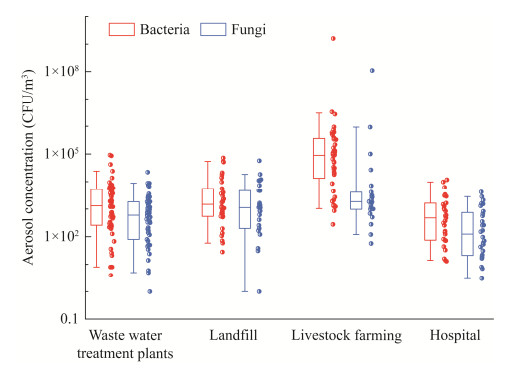
1.1 浓度分布特征对来自六大洲23个国家包括污水处理厂、垃圾填埋场、畜禽养殖场、医院的微生物气溶胶浓度数据(共计107条)进行统计分析。结果表明(图 2),相较其他3类人为源,畜禽养殖场微生物气溶胶中细菌浓度和真菌浓度的平均值均为最高;并且,圈舍内是畜禽养殖场微生物气溶胶的主要检出点位[10]。污水处理厂、垃圾填埋场这2类污染物处理处置场所微生物气溶胶的平均浓度相对居中,污水处理室内操作单元、垃圾收集区和倾倒区分别是污水处理厂和垃圾填埋场微生物气溶胶的主要检出点位[11-14]。医院门诊诊室、病房内微生物气溶胶的平均浓度较低,其中细菌浓度和真菌浓度分别介于1.3×101−1.1×10⁴ CFU/m3和0−4.1×103 CFU/m3之间,究其原因主要可能是医院门诊诊室、病房内随时会进行空气消毒,从而有效杀灭了这些场所微生物气溶胶中的细菌和真菌[15-16]。同时,总体分析也可以看出,无论哪类人为源,微生物气溶胶中真菌的平均浓度均小于相应点位微生物气溶胶中细菌的平均浓度,并且畜禽养殖场微生物气溶胶中真菌的平均浓度与其中细菌的平均浓度相差最大。如表 1所示,除南美洲外,其余地区微生物气溶胶浓度均符合上述分布特征。
|
| 图 2 不同人为源微生物气溶胶中的细菌、真菌浓度范围 Figure 2 Bacterial and fungal concentration ranges in microbial aerosols from different anthropogenic sources. |
|
|
| Continents | Bacterial concentration in microbial aerosols (CFU/m3) | Fungal concentration in microbial aerosols (CFU/m3) | |||||||
| Waste water treatment plants | Landfill | Livestock farming | Hospital | Waste water treatment plants | Landfill | Livestock farming | Hospital | ||
| Asia | 4−9.2×10⁴ | 2.8×101−1.8×10⁴ | 1.9×10³−3.3×10⁶ | 1.6×101−3.4×10³ | 1−2.2×10⁴ | 3.1×101−1.1×10⁴ | 6.9×10²−1.0×10⁵ | 8−2.8×10³ | |
| Europe | 0−2.4×10⁴ | 1.3×10²−7.2×10⁴ | 1.2×10³−1.6×10⁹ | 1.3×101−1.2×10⁴ | 0−6.7×10³ | 3.8×101−5.7×10⁴ | 1.2×10²−1.1×10⁸ | 0−1.6×10³ | |
| Africa | 1.1×10²−3.0×10³ | 9.2×10⁴−2.7×10⁶ | 3.3×101−9.7×10³ | 0−4.3×10³ | 0−7.3×10³ | 1.8×10³−2.7×10⁴ | 2.0×101−4.2×10³ | ||
| South America | 5.9×101−1.8×10³ | 1.2×10²−5.7×10² | 1.6×10³−4.7×10³ | 4.3×101−1.3×10³ | |||||
| North America | 8−2.1×10³ | 9.7×10³−5.1×10⁴ | 8.7×10²−7.6×10⁵ | 1.4×10²−2.6×10² | 5.7×101−9.3×10⁵ | 3−2.6×10² | |||
| Oceania | 2.8×10²−6.1×10⁴ | 5.1×10²−2.8×10³ | |||||||
当然,即使是同一类人为源,微生物气溶胶浓度分布特征也存在显著的区域差异或季节差异[17-18]。Yang等[19]对我国北方某城市污水处理厂微生物气溶胶逸散特征开展了为期一年的实地研究,结果发现该厂微生物气溶胶浓度变化呈现显著季节性差异,冬季微生物气溶胶中细菌检出量最高;Han等[20]对我国南方城市污水处理厂微生物气溶胶特征的长期研究结果也发现,这些地区污水处理厂微生物气溶胶浓度变化也呈现明显季节变化,但细菌最高浓度在春、夏季检出。同样的现象在南方某垃圾填埋场微生物气溶胶细菌浓度分布的研究中也被发现,微生物气溶胶中细菌最高浓度也在夏季检出[21]。
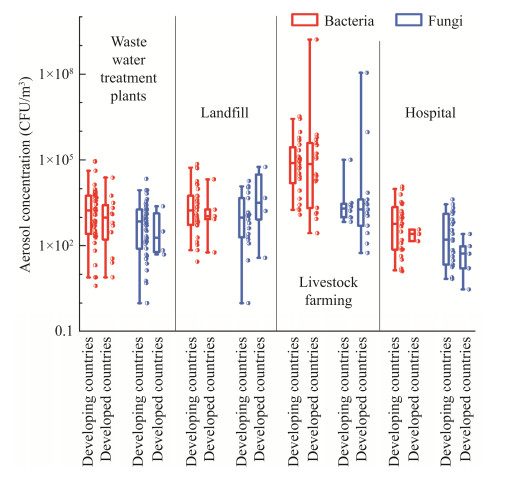
进一步分析不同人为源微生物气溶胶在各大洲的浓度分布特征(图 3和图 4)。结果发现,经济与管理水平均会对人为源微生物气溶胶浓度产生影响。欧洲、北美洲等经济发达国家的医院微生物气溶胶浓度远低于非洲经济欠发达国家,其中最主要的原因之一在于经济发展水平在一定程度上决定了当地医院诊室、病房内通风、消毒等设施的建设水平,进而影响了微生物气溶胶中微生物的种类及含量。同时,完善而严格的管理措施也会对微生物气溶胶的浓度产生影响。诸如波兰、加拿大等畜牧养殖业较为发达的国家,不仅严格限制养殖规模和数量,同时也严格实施动物防疫和检疫,这些国家畜禽养殖圈舍内微生物气溶胶浓度也处于较低水平[22]。
|
| 图 3 不同国家性质对不同人为源微生物气溶胶浓度的影响 Figure 3 Effect of different country properties on microbial aerosol concentrations from different anthropogenic sources. |
|
|

|
| 图 4 不同人为源在各大洲中气溶胶浓度范围分布 Figure 4 Aerosol concentration range distribution of different anthropogenic sources in each continent. |
|
|
粒径是微生物气溶胶最重要的基本属性之一,其分布特征与人体暴露风险直接相关。已有研究表明,微生物气溶胶粒径与人体呼吸道的沉积位置和沉积速率密切相关[23],PM10主要沉积在上呼吸道,PM2.5主要沉积在肺部,PM1可以进入肺泡内(图 5),超细颗粒可以通过人体血液循环系统转移到肝脏、脾脏、心脏甚至大脑[24-25]。

|
| 图 5 不同大小的颗粒在呼吸道内不同位置的沉积 Figure 5 Deposition of particles of different sizes in different locations in the respiratory tract. |
|
|
分析已有研究结果可以看出,污水处理厂不同处理工段微生物气溶胶粒径分布特征呈现显著差异[17-20, 26-27]。预处理工段(诸如格栅间、初沉池、沉砂池等)微生物气溶胶粒径以大于3.3 μm为主[27],生物处理工段(厌氧池、缺氧池和好氧池)微生物气溶胶粒径以小于3.3 μm为主,而污泥脱水间微生物气溶胶粒径则主要为3.3−4.7 μm[17-18]。与之类似,垃圾填埋场不同工段微生物气溶胶粒径分布特征也呈现明显差异[21, 28-29]。垃圾堆放区与填埋作业区微生物气溶胶粒径以大于4.7 μm为主,渗滤液收集与处理区微生物气溶胶粒径主要为1.1−3.3 μm,而填埋覆膜区微生物气溶胶粒径则主要为0.65−2.10 μm[21, 29]。
畜禽养殖场微生物气溶胶粒径分布特征与其牲畜养殖种类密切相关。目前研究发现,鸡舍、猪舍、牛舍微生物气溶胶粒径普遍较大,大多数均为6.0 μm以上[30-31],而马厩中微生物气溶胶粒径整体较小,检出小于4.7 μm粒径的微生物气溶胶占总微生物气溶胶的75%以上[22]。
除手术室和骨科病房外[32],医院诊区和病房微生物气溶胶粒径整体偏小。Coggins等监测了足科诊所微生物气溶胶特征,结果表明,其粒径主要为1.1−3.3 μm[33]。张金萍等采用对数回归法计算了医院不同诊区(呼吸科候诊厅、儿科候诊厅、口腔诊室、门诊大厅)微生物气溶胶的中值粒径,结果发现所有诊区微生物气溶胶粒径均小于3.3 μm[34]。
2 主要人为源微生物气溶胶中微生物的组成微生物气溶胶中最主要的组分是细菌、真菌、病毒、放线菌等微生物,污水处理厂、垃圾填埋场、医院、畜禽养殖场由于其场所特异性,其组分也可能存在一定差异(图 6)。识别并比较不同人为源气溶胶的微生物组分特征对其后续控制具有重要意义(表 2)。

|
| 图 6 人为源中优势菌属及常见病毒的种类 Figure 6 Types of dominant genera and common viruses in anthropogenic sources. |
|
|
| Anthropogenic sources | Bacteria | Fungi | Virus | References |
| Waste water treatment plants | Aeromonas, Bacillus, Clostridium, Pseudomonas, Sphingomonas, Staphylococcus | Aspergillus, Boeremia, Cladosporium, Cochliobolus, Davidiella, Mucor, Penicillium | Adenoviruses, Noroviruses, Rotaviruses | [20, 35-39] |
| Landfill | Bacillus, Kocuria, Micrococcus, Pseudomonas, Spirillum, Staphylococcus, Streptococcus | Alternaria, Aspergillus, Cladosporium, Curvularia, Penicillium, Rhizopus | Adenoviruses, Hepatitisvirus | [40-42] |
| Livestock farming | Corynebacterium, Enterobacter, Escherichia, Micrococcus, Pantoea, Staphylococcus, Streptococcus | Acremonium, Alternaria Nees, Aspergillus, Cladosporium, Curvularia, Fusarium, Paecilomyces, Penicillium, Rhodotorula, Saccharomyces, Trichoderma | Hepatitisvirus, Picobirnaviruses | [43-49] |
| Hospital | Acinetobacter baumannii, Bacillus, Escherichia, Enterococcus, Kocuria, Micrococcus, Pseudomonas, Rhodococcus spp., Staphylococcus aureus, Staphylococcus epidermidis | Aspergillus, Alternaria, Chrysosporium, Candida, Gladaxporism, Penicillium, Fusarium | Adenoviruses, Influenzavirus, Respiratory syncytial virus | [6, 50-56] |
污水生物处理系统中,细菌在有机物代谢方面起着至关重要的作用。因此,污水处理厂微生物气溶胶组分中细菌含量也占据绝对优势,并且其中还包含多种潜在致病性细菌。比较我国2个地区城市污水处理厂微生物气溶胶中细菌种群结构,结果显示,其中检出的主要潜在致病性细菌分别隶属于肠杆菌属(Enterobacter)、气单胞菌属(Aeromonas)、鲍曼不动杆菌属(Acinetobacter)、芽孢杆菌属(Bacillus)、假单胞菌属(Pseudomonas)、鞘氨醇单胞菌属(Sphingomonas)、葡萄球菌属(Staphylococcus)[35-37]。同样地,细菌在垃圾填埋场、畜禽养殖场和医院微生物气溶胶中也都是主要组分,但不同人为源微生物气溶胶中潜在致病性细菌种类存在一定差异。垃圾填埋场微生物气溶胶中检出的主要潜在致病性细菌分别隶属于芽孢杆菌属(Bacillus)、链球菌属(Streptococcus)、球菌属(Coccus)、螺旋菌属(Spirillum)[40];生猪养殖场微生物气溶胶中检出的潜在致病性细菌主要隶属于链球菌属(Streptococcus)[43],家禽养殖场微生物气溶胶中检出的潜在致病性细菌则分别隶属于肠杆菌属(Enterobacter)和埃希氏菌属(Escherichia)[44];医院不同诊区微生物气溶胶中潜在致病性细菌种类具有显著差异,皮肤科病房主要检出的是金黄色葡萄球菌(Staphylococcus aureus)和表皮葡萄球菌(Staphylococcus epidermidis)[50-51],外科病房中主要检出的是肠球菌属(Enterococcus)[52],重症监护病房(intensive care unit, ICU)主要检出的是不动杆菌属(Acinetobacter)、埃希氏菌属(Escherichia)和假单胞菌属(Pseudomonas)[53]。此外,污水处理厂、垃圾填埋场和畜禽养殖场微生物气溶胶中均检出了易对人体肺部造成严重感染的放线菌门细菌玫瑰色微球菌(Micrococcus roseus)和藤黄微球菌(Micrococcus luteus)[6, 57-59]。
2.2 真菌真菌是人为源微生物气溶胶中最重要的另一种微生物组分,当其浓度达到一定水平后也会引起人体的过敏反应[60]。综合分析不同人为源微生物气溶胶中的真菌种群结构,结果发现,4类人为源微生物气溶胶中检出的共同潜在致病性真菌分别隶属于青霉属(Penicillium)、曲霉属(Aspergillus)和枝孢属(Cladosporium)[40, 45, 61-62]。当然,不同人为源微生物气溶胶中也检出了一些相对含量较高的特征性真菌菌属。例如,污水处理厂微生物气溶胶中的旋孢腔菌属(Cochliobolus)和大孢枝孢菌属(Davidiella)[20],垃圾填埋场微生物气溶胶中的根霉属(Rhizopus)、链格孢属(Alternaria)和弯孢属(Curvularia)[41],生猪养殖场微生物气溶胶中的枝顶孢属(Acremonium)[45],家禽养殖场微生物气溶胶中的链格孢属(Alternaria)、根霉属(Rhizopus)、帚霉属(Scopulariopsis)和毛癣菌属(Trichophyton)[46-47],以及医院诊区的链格孢属(Alternaria)、镰孢属(Fusarium)和念珠菌属(Candida)[6]。
2.3 病毒在飞沫或者气溶胶传播的疾病中,病毒感染通常是最为常见的,其感染对象十分广泛,包括人体、动物和植物。研究发现,污水处理厂微生物气溶胶中最常检出的是呼吸道和胃肠道病毒,包括腺病毒(Adenoviruses)、轮状病毒(Rotaviruses)和诺如病毒(Noroviruses)[38-39, 63]。垃圾填埋场微生物气溶胶中主要检出的病毒则为肝炎病毒(Hepatitisvirus)和腺病毒(Adenoviruses)[42]。畜禽养殖场微生物气溶胶中检出的病毒更多是属于粪-口传播型病毒,如戊型肝炎病毒(hepatitis e virus, HEV)和皮埃尔纳维亚病毒(Picobirnaviruses)[48-49]。医院微生物气溶胶中检出的病毒主要与呼吸道疾病相关,包括腺病毒(Adenoviruses)、呼吸道合胞病毒(respiratory syncytial virus, RSV)和流感病毒(Influenzavirus),这些病毒会引起发烧、咳嗽、头痛和哮喘,严重的感染会导致肝脏、肾脏和心脏功能受损,引起肺炎、败血症,甚至死亡[54-56]。
3 主要人为源微生物气溶胶的影响因素已有研究发现,无论哪类来源,对微生物气溶胶特征产生影响的主要因素都可以分为两大类:源特性与单元操作方式影响和环境条件影响。
3.1 源特性与单元操作方式影响影响人为源微生物气溶胶组成特征的主要因素之一为源特性。溯源研究结果发现,污水处理厂微生物气溶胶中微生物种群结构与污水、污泥中微生物种群结构高度相似,尤其是在污水处理厂室内工段,诸如格栅间和污泥脱水间[18, 64]。垃圾填埋场中,由于不同填埋区域的填埋时限不同,废弃物样本中微生物种群具有明显差异,这种差异基本与相应区域微生物气溶胶中微生物种群结构差异相一致[29]。畜禽养殖场微生物气溶胶中微生物种群结构与畜禽粪污中微生物种群结构相似[65]。医院不同诊区微生物气溶胶中微生物种群结构与其所在诊区病人类型密切相关[34]。以上结果均表明,人为源的特性对于其微生物气溶胶的组分具有重要影响。
人为源单元操作方式也是影响微生物气溶胶特征的重要因素。通过对某污水处理厂2种曝气方式条件下微生物气溶胶特征的比较研究发现,在进水水质相同的前提下,与表面转刷条件下相比,底部微孔曝气条件下产生的微生物气溶胶浓度更低、平均粒径更小[66]。杨亚飞等在比较倒伞曝气与微孔曝气产生的微生物气溶胶特征时发现,倒伞曝气条件下产生的微生物气溶胶粒径主要为1.1−2.1 μm,而微孔曝气条件下产生的微生物气溶胶粒径则主要为4.7−7.0 μm[67]。Wang等研究发现,浸没式曝气条件下产生的平均粒径小于2.5 μm的微生物气溶胶在总微生物气溶胶颗粒中占比可达67.2%,但是表面曝气条件下产生的平均粒径小于2.5 μm的微生物气溶胶在总微生物气溶胶颗粒中占比仅为24.3%[68]。
垃圾填埋场和畜禽养殖场中,单元操作方式对各自微生物气溶胶特征也有影响,并且主要体现在其浓度特征方面。在垃圾填埋场,垃圾倾倒、运输、压实和覆盖操作过程中,由于机械扰动的加剧,促进了这些区域微生物气溶胶的大量产生[21, 28-29, 40, 69-70]。畜禽养殖场中单元操作方式较复杂,机械化饲养方式、自动化粪污收集方式、圈舍通风及清洁方式,甚至牲畜的日常活动行为均会对畜禽养殖场微生物气溶胶特征造成影响[22, 30-31]。研究发现,小规模养殖场在2.5 μm以下粒径的微生物气溶胶浓度比大规模养殖场同等粒径的微生物气溶胶浓度要高出3倍以上,而采用传统人工喂养和自然通风模式养殖场2.5 μm以下粒径的微生物气溶胶浓度比采用机械化喂养和通风模式养殖场的高出4倍以上[71]。
相较于前3类,对医院诊区微生物气溶胶特征影响最大的单元操作方式基本为消杀方式和通风方式[6, 45, 72]。
3.2 环境因素微生物气溶胶中最主要的组分是具有活性的微生物。因此,无论哪类人为源产生的微生物气溶胶,一旦逸散至大气环境中,外界环境条件的变化对其特征影响都很大。综合分析现有研究结果发现,温湿度、风向风速、光照度、大气无机污染物、沙尘、雨雪等均会对微生物气溶胶特征产生不同程度的影响(图 7)。

|
| 图 7 影响微生物气溶胶的环境条件 Figure 7 Environmental conditions affecting microbial aerosols. |
|
|
对于人为源室外区域,如垃圾填埋场的填埋区域、污水处理厂的曝气单元等,光照度是影响微生物气溶胶种类和浓度的重要因素之一[8, 68]。强光条件下,紫外线辐射、高温低湿等均会对微生物气溶胶中的微生物生长和繁殖造成影响,尤其是对于部分光敏性微生物种群而言,高光照度更是具有一定的灭活作用[73]。而且,高的光照强度还能减少植被和土壤中的微生物进入空气,从而进一步影响这些区域微生物气溶胶的组成和浓度[74]。然而也有学者研究发现,光照对某些真菌孢子的释放具有促进作用,适宜的光照度有助于空气中某些真菌生长和繁殖,从而使空气中微生物气溶胶的真菌含量升高[75]。
风速与风向主要是通过影响微生物气溶胶的扩散规律来影响室外区域微生物气溶胶的浓度和种类[20, 76]。低风速条件下,微生物气溶胶扩散受到限制,只能在产生源附近传播,并且低气流还可将近地面粒径较小的微生物气溶胶吹入高空中,从而使该区域微生物气溶胶浓度升高;而当风速较高,有利于微生物气溶胶的扩散时,其浓度将呈现降低趋势。研究表明,当风速小于2 m/s时,微生物气溶胶浓度随风速的增加而逐渐升高;当风速大于2 m/s时,其浓度会随风速的增加逐渐降低,并且顺风风向上的微生物气溶胶浓度远高于逆风风向上的浓度[77]。
同时,室外植被、绿化等也会影响微生物气溶胶特征。研究发现,某些植物分泌的挥发性物质可有效杀灭微生物气溶胶中的细菌,从而降低微生物气溶胶中细菌含量;与此同时,植被也能为真菌孢子的生长提供基质,从而使微生物气溶胶中的真菌含量升高[78]。
当暴发一些特殊气象条件如沙尘事件时,人为源微生物气溶胶的特征也将发生相应变化,沙尘发生时,不仅空气中微生物气溶胶总浓度会显著升高(P < 0.05),而且一些病原微生物会随沙尘的发生进行急剧传播[79-82]。除此之外,雨雪天气会导致微生物气溶胶浓度降低,但是雾霾天气则通常会导致微生物气溶胶浓度升高[83-85]。
对于人为源室内区域,如医院诊室、污水处理厂污泥脱水间等,温湿度则是影响微生物气溶胶特征的主要因素[86]。研究发现,当环境温度在20 ℃左右时,这些区域微生物气溶胶浓度最高[87],并且微生物气溶胶中的细菌浓度与相对湿度呈显著正相关关系[88]。
4 主要人为源微生物气溶胶的暴露风险评估微生物气溶胶主要的暴露途径包括呼吸摄入和皮肤接触。现行主要采用的暴露风险评估方法为美国环保署(United States Environmental Protection Agency, USEPA)推荐的暴露风险评价方法。该方法认为,当HQ < 1或HI < 1时,风险较小或可以忽略;当HQ > 1或HI > 1时,风险较大,对人体存在潜在危害[89]。目前也有学者结合我国《室内空气质量标准》(GB/T 18883—2002)中细菌总数限定值和中国科学院生态环境研究中心推荐的大气微生物评价限值对人为源微生物气溶胶的潜在危害进行了初步评价[90]。
已有评估结果表明,污水处理厂微生物气溶胶均为非致癌性气溶胶[91]。呼吸摄入是污水处理厂微生物气溶胶的主要暴露途径,通过呼吸摄入的风险值是通过皮肤接触风险值的104倍以上[92-93],并且男性的暴露风险比女性要高出7.2%−26.7%[94],这主要是因为男、女的呼吸速率差异所造成的[37]。污水处理厂各工艺段均是微生物气溶胶的主要暴露风险点,目前的研究表明,原污水入口处、格栅间、曝气池、污泥脱水间暴露水平均较高[27, 95-96]。因此,污水处理厂各工段工人、检修人员等均应配备口罩、防护服等基本防护措施,以减少现场人员的暴露风险[19, 37]。
填埋区和渗滤液收集处理区是垃圾填埋场微生物气溶胶最主要的暴露风险区[21, 97-98]。在填埋场附近儿童经呼吸摄入的风险远大于成年男性和成年女性[28, 41]。因此,学者建议垃圾填埋场选址应距居民居住区至少2 km,以避免被致病微生物所感染[99]。
在不进行任何防护的前提下,畜禽养殖场饲养人员一天(8 h)可吸入约6.1×10⁵ CFU/d (鸡舍)、4.7×10⁴ CFU/d (猪舍)和3.6×10⁴ CFU/d (牛舍)的细菌[30]。其中微生物气溶胶粒径越小,其进入呼吸道的深度越深。因此,长期无防护暴露于这种条件下会导致饲养人员对病原微生物的敏感性增高、抵抗力下降,从而对人体健康造成危害[100-101]。因此,学者建议畜禽养殖场与居民居住区距离至少在200 m以上[102],并且尽量减少粗放式水冲清洁方式[65, 103]。
医院诊室内微生物气溶胶中的细菌、真菌对医务人员的日均(8 h)潜在暴露量为1.4×10³−4.1×10³ CFU/d和4.8×102−1.6×103 CFU/d,对就诊人员的日均(2 h)潜在暴露量为1.4×10²−1.1×10³ CFU/d和5.0×101−4.0×102 CFU/d,由于暴露时间的差异,医护人员的暴露风险明显高于就诊人员[52]。另外,研究发现,在医院内成年男性通过呼吸摄入和皮肤接触造成的微生物气溶胶暴露风险明显高于成年女性,新生儿的暴露风险尤其值得关注[6, 104]。针对医院中的气溶胶浓度,世界卫生组织(World Health Organization, WHO)的指导方针明确指出,医院微生物气溶胶中的细菌浓度应低于1.0×10² CFU/m³,真菌浓度应低于5.0×101 CFU/m³[6]。
5 结论与展望已有研究发现,4类人为源微生物气溶胶的主要逸散点位与其工艺过程高度相关。污水处理厂微生物气溶胶的主要逸散点位为污泥脱水间和曝气池,垃圾填埋场微生物气溶胶主要逸散点位为垃圾填埋区和渗滤液收集区,畜禽养殖场和医院诊区微生物气溶胶的主要逸散点位则主要集中在室内区域,例如养殖圈舍和病房。不同人为源之间比较的结果表明,垃圾填埋场和畜禽养殖场产生的微生物气溶胶粒径较大,大多数大于3.3 μm,而医院产生的微生物气溶胶粒径较小,基本小于3.3 μm[21, 29-30, 33-34]。对于微生物种类而言,4类人为源微生物气溶胶中既检出了共性种属(诸如葡萄球菌属和青霉属),同时也发现不同人为源微生物气溶胶中存在特异性微生物。例如,污水处理厂微生物气溶胶中检出的病毒主要为腺病毒、轮状病毒和诺如病毒,医院微生物气溶胶中检出的病毒则主要为呼吸道合胞病毒和流感病毒。不同人为源微生物气溶胶特征的差异与其产生源特性密切相关,同时也受其所处环境因素(诸如光照度、风速风向、温湿度等)的显著影响。这些人为源产生的微生物气溶胶主要通过呼吸摄入对人体产生暴露风险。因此,污水处理厂、垃圾填埋场和畜禽养殖场职工应像医院职工一样,做好日常基本防护,佩戴口罩、手套,穿防护性工作服,尽可能降低这些场所的微生物气溶胶暴露风险。
目前,关于人为源微生物气溶胶特征的研究已全面开展,并得出了一系列有益研究成果,但仍然在风险评估、控制标准制定和控制技术研发等方面存在3个问题。
(1) 风险评估不足。现有研究中关于微生物气溶胶暴露风险评估主要采用的方法基于美国环保署推荐的暴露剂量反应关系。该方法主要依据的是微生物气溶胶的暴露浓度、暴露途径、人体暴露频率等,其中暴露参考剂量选用的是室内场所空气中细菌浓度。目前该方法忽略了微生物气溶胶中其他潜在致病微生物(如真菌、病毒、支原体、衣原体等)及这些微生物是否具有活性,从而可能严重低估了人为源微生物气溶胶的潜在风险。例如,污水处理厂微生物气溶胶中存在的诺如病毒虽然含量较低,但其一旦感染人体后会在体内大量繁殖,进而对人体健康造成巨大危害。
(2) 控制标准缺失。近年来,随着研究的大量展开,人为源微生物气溶胶潜在风险已经得到越来越多的关注。然而,目前国内外也仅仅是对室内工作区域空气中细菌总数进行了限定,但尚未对这些场所微生物气溶胶制定详细而精确的控制标准。例如,风险物质确定、风险阈值限定及风险物质样本的采集和测定等。控制标准缺失一定程度上影响了控制策略的选择与制定。
(3) 控制技术不明。目前4类人为源选择的微生物气溶胶控制方法主要集中在源头加盖掩蔽和消毒剂消杀两个方面。源头加盖掩蔽仅仅是阻断了微生物气溶胶的扩散,并未从根本上实现其削减;而消毒剂消杀则仅仅对室内区域微生物气溶胶具有良好效果。目前在这些方法的选择上也较为随意,缺乏对不同致病微生物灭活的针对性。
基于以上问题,未来应集中在以下4个方面展开深入研究。
(1) 建立精准的人为源微生物气溶胶风险评估方法和体系。深入研究人为源微生物气溶胶中不同致病微生物的活性、其在人体中的存活概率、繁殖速率及其相互之间的作用关系等,结合人体对这些致病性物质的反应关系,构建人为源微生物气溶胶潜在致病微生物清单;通过参数筛选及权重分析,确定不同潜在致病微生物暴露剂量,建立人为源微生物气溶胶风险评估模型;综合模型计算与实际调研,构建适宜于不同人为源微生物气溶胶的风险评估方法和体系。
(2) 制定详尽的人为源微生物气溶胶控制标准。在风险评估方法和体系构建的基础上,通过参数识别、比对和优化,确定微生物气溶胶中不同控制层级的控制物质、控制阈值等,为人为源微生物气溶胶控制标准的尽快制定奠定基础。
(3) 研发适宜的人为源微生物气溶胶控制技术和装备。针对4类人为源不同区域特性,深入研究物理、化学等方法对其微生物气溶胶中不同致病组分的削减机制,进而研发适宜的微生物气溶胶控制技术和装备。
(4) 目前针对微生物气溶胶的研究主要集中于城市区域。近年来,随着我国乡村人居环境综合整治项目的快速实施,乡村地区污水、垃圾、养殖废物等的处理处置也日益受到重视。在此过程中,超前考虑此区域气态污染物尤其是微生物气溶胶的产生和逸散规律,不仅可提升我国乡村地区整体环境质量,而且还可避免形成新的潜在暴露风险。因此,未来建议针对乡村地区微生物气溶胶特征展开深入研究。
| [1] |
MBANGA J, ABIA ALK, AMOAKO DG, ESSACK SY. Quantitative microbial risk assessment for waterborne pathogens in a wastewater treatment plant and its receiving surface water body[J]. BMC Microbiology, 2020, 20(1): 346. DOI:10.1186/s12866-020-02036-7 |
| [2] |
HAAS D, KRISO A, FRITZ T, GALLER H, HABIB J, ILIEVA M, KROPSCH M, OFNER-KOPEINIG P, STONITSCH M, STRASSER A, ZENTNER E, REINTHALER FF. Background concentrations of cultivable, mesophilic bacteria and dust particles in the air in urban, rural and mountain regions[J]. International Journal of Environmental Research and Public Health, 2020, 17(24): 9572. DOI:10.3390/ijerph17249572 |
| [3] |
SIEBIELEC S, WOŹNIAK M, GAŁĄZKA A, SIEBIELEC G. Microorganisms as indoor and outdoor air biological pollution[J]. Postępy Mikrobiologii - Advancements of Microbiology, 2020, 59(2): 115-127. DOI:10.21307/PM-2020.59.2.009 |
| [4] |
HAN YP, YANG T, YAN X, LI L, LIU JX. Effect of aeration mode on aerosol characteristics from the same wastewater treatment plant[J]. Water Research, 2020, 170: 115324. DOI:10.1016/j.watres.2019.115324 |
| [5] |
WORLD HEALTH ORGANIZATION. The burden of health care-associated infection worldwide[J]. World Health Organization, 2010.
|
| [6] |
NASIRI N, GHOLIPOUR S, AKBARI H, KOOLIVAND A, ABTAHI H, DIDEHDAR M, REZAEI A, MIRZAEI N. Contamination of obsterics and gynecology hospital air by bacterial and fungal aerosols associated with nosocomial infections[J]. Journal of Environmental Health Science and Engineering, 2021, 19(1): 663-670. DOI:10.1007/s40201-021-00637-6 |
| [7] |
BRUNI E, SIMONETTI G, BOVONE B, CASAGRANDE C, CASTELLANI F, RICCARDI C, POMATA D, DI FILIPPO P, FEDERICI E, BUIARELLI F, UCCELLETTI D. Evaluation of bioaerosol bacterial components of a wastewater treatment plant through an integrate approach and in vivo assessment[J]. International Journal of Environmental Research and Public Health, 2019, 17(1): 273. DOI:10.3390/ijerph17010273 |
| [8] |
NAIR AT. Bioaerosols in the landfill environment: an overview of microbial diversity and potential health hazards[J]. Aerobiologia, 2021, 37(2): 185-203. DOI:10.1007/s10453-021-09693-9 |
| [9] |
UHRBRAND K, SCHULTZ AC, KOIVISTO AJ, NIELSEN U, MADSEN AM. Assessment of airborne bacteria and noroviruses in air emission from a new highly-advanced hospital wastewater treatment plant[J]. Water Research, 2017, 112: 110-119. DOI:10.1016/j.watres.2017.01.046 |
| [10] |
RADON K, DANUSER B, IVERSEN M, MONSO E, WEBER C, HARTUNG J, DONHAM K, PALMGREN U, NOWAK D. Air contaminants in different European farming environments[J]. Annals of Agricultural and Environmental Medicine, 2002, 9(1): 41-48. |
| [11] |
LIU JW, CHEN XY, TANG WB, ZANG NN, FENG WT, LU C, SUN JB. Selection of odor and microbial aerosol gas treatment technology in different functional areas of municipal wastewater treatment plant[J]. Applied Chemical Industry, 2022, 51(5): 1530-1534. (in Chinese) 刘建伟, 陈欣玥, 唐文邦, 臧娜娜, 冯文韬, 鲁晨, 孙建斌. 城市污水厂不同功能区含恶臭和微生物气溶胶气体处理技术选择[J]. 应用化工, 2022, 51(5): 1530-1534. DOI:10.3969/j.issn.1671-3206.2022.05.060 |
| [12] |
LIS DO, ULFIG K, WLAZŁO A, PASTUSZKA JS. Microbial air quality in offices at municipal landfills[J]. Journal of Occupational and Environmental Hygiene, 2004, 1(2): 62-68. DOI:10.1080/15459620490275489 |
| [13] |
LIU JW, ZHOU JN, MA WL. Research on the pollution characteristics of microbial aerosol in municipal wastewater treatment plant in Beijing[J]. Environmental Pollution & Control, 2013, 35(6): 1-4, 31. (in Chinese) 刘建伟, 周竞男, 马文林. 北京市某城市污水处理厂微生物气溶胶污染特性研究[J]. 环境污染与防治, 2013, 35(6): 1-4, 31. DOI:10.3969/j.issn.1001-3865.2013.06.001 |
| [14] |
SCHLOSSER O, ROBERT S, DEBEAUPUIS C. Aspergillus fumigatus and mesophilic moulds in air in the surrounding environment downwind of non-hazardous waste landfill sites[J]. International Journal of Hygiene and Environmental Health, 2016, 219(3): 239-251. DOI:10.1016/j.ijheh.2016.02.003 |
| [15] |
GÓRNY RL, FRĄCZEK K, ROPEK DR. Size distribution of microbial aerosols in overground and subterranean treatment Chambers at health resorts[J]. Journal of Environmental Health Science and Engineering, 2020, 18(2): 1437-1450. DOI:10.1007/s40201-020-00559-9 |
| [16] |
FEKADU S, GETACHEWU B. Microbiological assessment of indoor air of teaching hospital wards: a case of jimma university specialized hospital[J]. Ethiopian Journal of Health Sciences, 2015, 25(2): 117-122. DOI:10.4314/ejhs.v25i2.3 |
| [17] |
YANG T, HAN YP, ZHANG MZ, XUE S, LI L, LIU JX, QIU ZP. Characteristics and exposure risks of potential pathogens and toxic metal(loid)s in aerosols from wastewater treatment plants[J]. Ecotoxicology and Environmental Safety, 2019, 183: 109543. DOI:10.1016/j.ecoenv.2019.109543 |
| [18] |
HAN YP, YANG T, XU GS, LI L, LIU JX. Characteristics and interactions of bioaerosol microorganisms from wastewater treatment plants[J]. Journal of Hazardous Materials, 2020, 391: 122256. DOI:10.1016/j.jhazmat.2020.122256 |
| [19] |
YANG T, JIANG L, HAN YP, LIU JW, WANG XD, YAN X, LIU JX. Linking aerosol characteristics of size distributions, core potential pathogens and toxic metal(loid)s to wastewater treatment process[J]. Environmental Pollution, 2020, 264: 114741. DOI:10.1016/j.envpol.2020.114741 |
| [20] |
HAN YP, YANG KX, YANG T, ZHANG MZ, LI L. Bioaerosols emission and exposure risk of a wastewater treatment plant with A2O treatment process[J]. Ecotoxicology and Environmental Safety, 2019, 169: 161-168. DOI:10.1016/j.ecoenv.2018.11.018 |
| [21] |
LI L, MA JW, YANG KX, CHAI FG, LIU JX, GUO XS. Microbial aerosol particles in four seasons of sanitary landfill site: Molecular approaches, traceability and risk assessment[J]. Journal of Environmental Sciences, 2021, 108: 120-133. DOI:10.1016/j.jes.2021.01.013 |
| [22] |
GRZYB J, PODSTAWSKI Z, BULSKI K. Bacterial aerosol, particulate matter, and microclimatic parameters in the horse stables in Poland[J]. Environmental Science and Pollution Research, 2022, 29(18): 26992-27006. DOI:10.1007/s11356-021-18142-6 |
| [23] |
MARQUES G, ROQUE FERREIRA C, PITARMA R. A system based on the Internet of things for real-time particle monitoring in buildings[J]. International Journal of Environmental Research and Public Health, 2018, 15(4): 821. DOI:10.3390/ijerph15040821 |
| [24] |
FALCON-RODRIGUEZ CI, OSORNIO-VARGAS AR, SADA-OVALLE I, SEGURA-MEDINA P. Aeroparticles, composition, and lung diseases[J]. Frontiers in Immunology, 2016, 7: 3. |
| [25] |
PRAKASH J, LOHIA T, MANDARIYA AK, HABIB G, GUPTA T, GUPTA SK. Chemical characterization and quantitativ e assessment of source-specific health risk of trace metals in PM1.0 at a road site of Delhi, India[J]. Environmental Science and Pollution Research, 2018, 25(9): 8747-8764. DOI:10.1007/s11356-017-1174-9 |
| [26] |
DING WJ, LI L, HAN YP, LIU JZ, LIU JX. Site-related and seasonal variation of bioaerosol emission in an indoor wastewater treatment station: level, characteristics of particle size, and microbial structure[J]. Aerobiologia, 2016, 32(2): 211-224. DOI:10.1007/s10453-015-9391-5 |
| [27] |
YANG T, HAN YP, LIU JX, LI L. Aerosols from a wastewater treatment plant using oxidation ditch process: characteristics, source apportionment, and exposure risks[J]. Environmental Pollution, 2019, 250: 627-638. DOI:10.1016/j.envpol.2019.04.071 |
| [28] |
LIU YY, ZHANG CM, ZHANG SH, DU WW, XU PC, WANG XC. Distribution and occupational exposure risk assessment of bacterial aerosols at a sanitary landfill site[J]. Acta Scientiae Circumstantiae, 2021, 41(11): 4459-4466. (in Chinese) 刘盈盈, 张崇淼, 张少华, 杜伟伟, 许鹏程, 王晓昌. 生活垃圾填埋场细菌气溶胶分布及职业暴露风险评估[J]. 环境科学学报, 2021, 41(11): 4459-4466. |
| [29] |
MA JW, YANG KX, CHAI FG, WANG Y, GUO XS, LI L. Particle size distribution and population characteristics of airborne bacteria emitted from a sanitary landfill site[J]. Environmental Science, 2019, 40(8): 3470-3476. (in Chinese) 马嘉伟, 杨凯雄, 柴风光, 王莹, 郭雪松, 李琳. 生活垃圾填埋场细菌气溶胶粒径分布及种群特征[J]. 环境科学, 2019, 40(8): 3470-3476. |
| [30] |
ZHONG ZB, WANG N. The size distrition and health risk assessment of microbe bacterial aerosol in livestock and poultry house[J]. China Animal Health Inspection, 2014, 31(11): 101-105. (in Chinese) 钟召兵, 王宁. 养殖环境细菌微生物气溶胶粒径分布及其健康危害评估[J]. 中国动物检疫, 2014, 31(11): 101-105. |
| [31] |
NGUYEN XD, ZHAO Y, EVANS JD, LIN J, PURSWELL JL. Survival of Escherichia coli in airborne and settled poultry litter particles[J]. Animals, 2022, 12(3): 284. DOI:10.3390/ani12030284 |
| [32] |
NASIR ZA, MULA V, STOKOE J, COLBECK I, LOEFFLER M. Evaluation of total concentration and size distribution of bacterial and fungal aerosol in healthcare built environments[J]. Indoor and Built Environment, 2015, 24(2): 269-279. DOI:10.1177/1420326X13510925 |
| [33] |
COGGINS MA, HOGAN VJ, KELLY M, FLEMING GTA, ROBERTS N, TYNAN T, THORNE PS. Workplace exposure to bioaerosols in podiatry clinics[J]. The Annals of Occupational Hygiene, 2012, 56(6): 746-753. |
| [34] |
ZHANG JP, ZHANG CL, WANG Z, WANG Z, LI AG, CAO GQ. Assessment of the exposure level and concentration of the indoor microbial aerosols in hospital buildings in winter, Beijing[J]. Building Science, 2020, 36(8): 180-186. (in Chinese) 张金萍, 张翠林, 王智, 王政, 李安桂, 曹国庆. 北京地区医院建筑冬季室内微生物气溶胶浓度水平及暴露评价[J]. 建筑科学, 2020, 36(8): 180-186. |
| [35] |
WANG YJ, LI L, HAN YP, LIU JX, YANG KX. Intestinal bacteria in bioaerosols and factors affecting their survival in two oxidation ditch process municipal wastewater treatment plants located in different regions[J]. Ecotoxicology and Environmental Safety, 2018, 154: 162-170. DOI:10.1016/j.ecoenv.2018.02.041 |
| [36] |
YANG T, JIANG L, BI XJ, CHENG LH, ZHENG X, WANG XD, ZHOU XL. Submicron aerosols share potential pathogens and antibiotic resistomes with wastewater or sludge[J]. The Science of the Total Environment, 2022, 821: 153521. DOI:10.1016/j.scitotenv.2022.153521 |
| [37] |
YAN C, LENG YL, WU JT. Quantitative microbial risk assessment for occupational health of temporary entrants and staffs equipped with various grade PPE and exposed to microbial bioaerosols in two WWTPs[J]. International Archives of Occupational and Environmental Health, 2021, 94(6): 1327-1343. DOI:10.1007/s00420-021-01663-5 |
| [38] |
STOBNICKA-KUPIEC A, GOŁOFIT-SZYMCZAK M, CYPROWSKI M, GÓRNY RL. Detection and identification of potentially infectious gastrointestinal and respiratory viruses at workplaces of wastewater treatment plants with viability qPCR/RT-qPCR[J]. Scientific Reports, 2022, 12: 4517. DOI:10.1038/s41598-022-08452-1 |
| [39] |
la ROSA G, POURSHABAN M, IACONELLI M, MUSCILLO M. Quantitative real-time PCR of enteric viruses in influent and effluent samples from wastewater treatment plants in Italy[J]. Annali Dell՚Istituto Superiore Di Sanita, 2010, 46(3): 266-273. |
| [40] |
MADHWAL S, PRABHU V, SUNDRIYAL S, SHRIDHAR V. Distribution, characterization and health risk assessment of size fractionated bioaerosols at an open landfill site in Dehradun, India[J]. Atmospheric Pollution Research, 2020, 11(1): 156-169. DOI:10.1016/j.apr.2019.10.002 |
| [41] |
WANG Y, HAN YP, LI L. Emission and potential risks of bioaerosols in sanitary landfill[J]. Microbiology China, 2020, 47(1): 222-233. (in Chinese) 王莹, 韩云平, 李琳. 卫生填埋场微生物气溶胶的逸散及潜在风险[J]. 微生物学通报, 2020, 47(1): 222-233. |
| [42] |
CARDUCCI A, FEDERIGI I, VERANI M. Virus occupational exposure in solid waste processing facilities[J]. The Annals of Occupational Hygiene, 2013, 57(9): 1115-1127. |
| [43] |
KRISTIANSEN A, SAUNDERS AM, HANSEN AA, NIELSEN PH, NIELSEN JL. Community structure of bacteria and fungi in aerosols of a pig confinement building[J]. FEMS Microbiology Ecology, 2012, 80(2): 390-401. DOI:10.1111/j.1574-6941.2012.01305.x |
| [44] |
GAO M, JIA RZ, QIU TL, SONG Y, WANG XM. Bacterial community of bioaerosols in atmospheric environment of confined poultry feeding operations[J]. Journal of Agro-Environment Science, 2015, 34(10): 1985-1990. (in Chinese) 高敏, 贾瑞志, 仇天雷, 宋渊, 王旭明. 集约化养鸡场舍内细菌气溶胶群落结构研究[J]. 农业环境科学学报, 2015, 34(10): 1985-1990. DOI:10.11654/jaes.2015.10.021 |
| [45] |
JARI H, MALEKI A, ATHAR SD, MOHAMMADI E, DARVISHI E, HEDAYATI MA, MARZBAN N, TANG VT, NOURI B. Airborne bacteria and fungi in a wastewater treatment plant: type and characterization of bio-aerosols, emission characterization and mapping[J]. Aerobiologia, 2022, 38(2): 163-176. DOI:10.1007/s10453-022-09740-z |
| [46] |
JO WK, KANG JH. Exposure levels of airborne bacteria and fungi in Korean swine and poultry sheds[J]. Archives of Environmental & Occupational Health, 2005, 60(3): 140-146. |
| [47] |
LUGAUSKAS A, KRIKSTAPONIS A, SVEISTYTE L. Airborne fungi in industrial environments: Potential agents of respiratory diseases[J]. Annals of Agricultural and Environmental Medicine: AAEM, 2004, 11(1): 19-25. |
| [48] |
WITHENSHAW SM, GRIERSON SS, SMITH RP. Study of animal mixing and the dynamics of hepatitis E virus infection on a farrow-to-finish pig farm[J]. Animals: an Open Access Journal from MDPI, 2022, 12(3): 272. |
| [49] |
RAMESH A, BAILEY ES, AHYONG V, LANGELIER C, PHELPS M, NEFF N, SIT R, TATO C, DERISI JL, GREER AG, GRAY GC. Metagenomic characterization of swine slurry in a North American swine farm operation[J]. Scientific Reports, 2021, 11: 16994. DOI:10.1038/s41598-021-95804-y |
| [50] |
MONTAZERI A, ZANDI H, TEYMOURI F, SOLTANIANZADEH Z, JAMBARSANG S, MOKHTARI M. Microbiological analysis of bacterial and fungal bioaerosols from burn hospital of Yazd (Iran) in 2019[J]. Journal of Environmental Health Science and Engineering, 2020, 18(2): 1121-1130. DOI:10.1007/s40201-020-00531-7 |
| [51] |
KARAMI N, MIRZAJANI F, REZADOOST H, KARIMI A, FALLAH F, GHASSEMPOUR A, ALIAHMADI A. Initial study of three different pathogenic microorganisms by gas chromatography-mass spectrometry[J]. F1000Research, 2017, 6: 1415. |
| [52] |
KHAN HA, BAIG FK, MEHBOOB R. Nosocomial infections: epidemiology, prevention, control and surveillance[J]. Asian Pacific Journal of Tropical Biomedicine, 2017, 7(5): 478-482. DOI:10.1016/j.apjtb.2017.01.019 |
| [53] |
DING JY, GUI H, HONG YY, GUO YH, WANG N, LIU QQ. Analysis of drug resistance characteristics of the dominant pathogenic bacteria in emergency intensive care unit based on the drug resistance gene[J]. Medical & Pharmaceutical Journal of Chinese PLA, 2015, 27(10): 72-75. (in Chinese) 丁军颖, 桂红, 洪燕英, 郭玉红, 王宁, 刘清泉. 基于耐药基因分析急诊重症监护病房优势病原菌耐药特性[J]. 解放军医药杂志, 2015, 27(10): 72-75. |
| [54] |
DU XK, WU GS, ZHU YF, ZHANG SQ. Exploring the epidemiological changes of common respiratory viruses since the COVID-19 pandemic: a hospital study in Hangzhou, China[J]. Archives of Virology, 2021, 166(11): 3085-3092. DOI:10.1007/s00705-021-05214-8 |
| [55] |
PAPADOPOULOS NG, CHRISTODOULOU I, ROHDE G, AGACHE I, ALMQVIST C, BRUNO A, BONINI S, BONT L, BOSSIOS A, BOUSQUET J, BRAIDO F, BRUSSELLE G, CANONICA GW, CARLSEN KH, CHANEZ P, FOKKENS WJ, GARCIA-GARCIA M, GJOMARKAJ M, HAAHTELA T, HOLGATE ST, et al. Viruses and bacteria in acute asthma exacerbations: a GA² LEN-DARE systematic review[J]. Allergy, 2011, 66(4): 458-468. DOI:10.1111/j.1398-9995.2010.02505.x |
| [56] |
SIGURS N, ALJASSIM F, KJELLMAN B, ROBINSON PD, SIGURBERGSSON F, BJARNASON R, GUSTAFSSON PM. Asthma and allergy patterns over 18 years after severe RSV bronchiolitis in the first year of life[J]. Thorax, 2010, 65(12): 1045-1052. DOI:10.1136/thx.2009.121582 |
| [57] |
BREZA-BORUTA B, PALUSZAK Z. Influence of water treatment plant on microbiological composition of air bioaerosol[J]. Polish Journal of Environmental Studies, 2007, 16(5): 663-670. |
| [58] |
NIELSEN BH, WÜRTZ H, BREUM NO, POULSEN OM. Microorganisms and endotoxin in experimentally generated bioaerosols from composting household waste[J]. Annals of Agriculture and Environmental Medicine, 1997, 4(1): 159-168. |
| [59] |
HAN YP, YANG T, CHEN TZ, LI L, LIU JX. Characteristics of submicron aerosols produced during aeration in wastewater treatment[J]. The Science of the Total Environment, 2019, 696: 134019. DOI:10.1016/j.scitotenv.2019.134019 |
| [60] |
PRIYAMVADA H, SINGH RK, AKILA M, RAVIKRISHNA R, VERMA RS, GUNTHE SS. Seasonal variation of the dominant allergenic fungal aerosols–one year study from southern Indian region[J]. Scientific Reports, 2017, 7: 11171. DOI:10.1038/s41598-017-11727-7 |
| [61] |
CHIEN YC, CHEN CJ, LIN TH, CHEN SH, CHIEN YC. Characteristics of microbial aerosols released from chicken and swine feces[J]. Journal of the Air & Waste Management Association, 2011, 61(8): 882-889. |
| [62] |
CABO VERDE S, ALMEIDA SM, MATOS J, GUERREIRO D, MENESES M, FARIA T, BOTELHO D, SANTOS M, VIEGAS C. Microbiological assessment of indoor air quality at different hospital sites[J]. Research in Microbiology, 2015, 166(7): 557-563. DOI:10.1016/j.resmic.2015.03.004 |
| [63] |
RODRÍGUEZ-LÁZARO D, COOK N, RUGGERI FM, SELLWOOD J, NASSER A, NASCIMENTO MSJ, D'AGOSTINO M, SANTOS R, SAIZ JC, RZEŻUTKA A, BOSCH A, GIRONES R. CARDUCCI A. MUSCILLO M, KOVAC K, DIEZ-VALCARCE M, VANTARAKIS A, von BONSDORFF CH, HUSMAN AMD, HERNANDEZ M, et al. Virus hazards from food, water and other contaminated environments[J]. FEMS Microbiology Reviews, 2012, 36(4): 786-814. DOI:10.1111/j.1574-6976.2011.00306.x |
| [64] |
XU GS, HAN YP, LI L, LIU JX. Characterization and source analysis of indoor/outdoor culturable airborne bacteria in a municipal wastewater treatment plant[J]. Journal of Environmental Sciences: China, 2018, 74: 71-78. DOI:10.1016/j.jes.2018.02.007 |
| [65] |
LI JZ, ZHOU BJ, JI XQ, WEN M, FU XL, LI SJ, YAN A, WANG XJ. Monitoring and drug tolerance analysis of bacteria in scaled pig farm[J]. Journal of Mountain Agriculture and Biology, 2011, 30(6): 554-557. (in Chinese) 李基棕, 周碧君, 嵇辛勤, 文明, 傅心亮, 李世静, 颜艾, 王相金. 猪场环境中主要病原菌耐药性分析[J]. 山地农业生物学报, 2011, 30(6): 554-557. DOI:10.3969/j.issn.1008-0457.2011.06.017 |
| [66] |
MIRHOSEINI SH, NIKAEEN M, SHAMSIZADEH Z, KHANAHMAD H. Hospital air: a potential route for transmission of infections caused by β-lactam-resistant bacteria[J]. American Journal of Infection Control, 2016, 44(8): 898-904. DOI:10.1016/j.ajic.2016.01.041 |
| [67] |
YANG YF, ALI W, ZHANG MM, CHEN YH, LENG YL, WANG RN, GUI ZC, YAN C. Characterization of microbial aerosol emission from a municipal wastewater treatment plant and quantitative microbiological risk assessment[J]. Water & Wastewater Engineering, 2021, 57(S1): 104-109. (in Chinese) 杨亚飞, WAJID Ali, 张蒙蒙, 陈彦欢, 冷雅丽, 王睿凝, 归梓成, 颜诚. 某市政污水处理厂的微生物气溶胶排放特征及其定量风险评价研究[J]. 给水排水, 2021, 57(增刊1): 104-109. |
| [68] |
WANG YJ, LI L, XUE S, HAN YP, YANG KX. Characteristics and formation mechanism of intestinal bacteria particles emitted from aerated wastewater treatment tanks[J]. Water Research, 2019, 163: 114862. DOI:10.1016/j.watres.2019.114862 |
| [69] |
LIU Y, ZHANG YY, SHI YT, SHEN FX, YANG Y, WANG MJ, ZHANG GY, DENG T, LAI SC. Characterization of fungal aerosol in a landfill and an incineration plants in Guangzhou, Southern China: the link to potential impacts[J]. The Science of the Total Environment, 2021, 764: 142908. |
| [70] |
MADSEN AM, FREDERIKSEN MW, BJERREGAARD M, TENDAL K. Measures to reduce the exposure of waste collection workers to handborne and airborne microorganisms and inflammogenic dust[J]. Waste Management, 2020, 101: 241-249. |
| [71] |
SOWIAK M, BRÓDKA K, BUCZYŃSKA A, CYPROWSKI M, KOZAJDA A, SOBALA W, SZADKOWSKA-STAŃCZYK I. An assessment of potential exposure to bioaerosols among swine farm workers with particular reference to airborne microorganisms in the respirable fraction under various breeding conditions[J]. Aerobiologia, 2012, 28(2): 121-133. |
| [72] |
YOUSEFZADEH A, MALEKI A, ATHAR SD, DARVISHI E, AHMADI M, MOHAMMADI E, TANG VT, KALMARZI RN, KASHEFI H. Evaluation of bio-aerosols type, density, and modeling of dispersion in inside and outside of different wards of educational hospital[J]. Environmental Science and Pollution Research, 2022, 29(10): 14143-14157. |
| [73] |
CHENG R, QI C, SHI L, ZHANG W, ZHENG X. Generation, transmission and risk assessment of microbial aerosols in sewage treatment facilities[J]. Water & Wastewater Engineering, 2020, 56(4): 59-69. (in Chinese) 程荣, 亓畅, 石磊, 张巍, 郑祥. 污水处理设施中微生物气溶胶的产生、传播及风险评估[J]. 给水排水, 2020, 56(4): 59-69. |
| [74] |
FU HL. Study on distribution characteristics of culturable bioaerosols under various weather conditions in Xi'an[D]. Xi՚an: Master՚s Thesis of Changan University, 2016 (in Chinese). 付红蕾. 西安市不同天气可培养微生物气溶胶的分布特性研究[D]. 西安: 长安大学硕士学位论文, 2016. |
| [75] |
WANG YY, ZHU HY, LIU DM, MA AM. Research progress in the effects of light on the growth and development of higher fungi[J]. Science and Technology of Food Industry, 2017, 38(21): 324-329. (in Chinese) 王媛媛, 朱涵予, 刘冬梅, 马爱民. 光照对高等真菌生长发育影响的研究进展[J]. 食品工业科技, 2017, 38(21): 324-329. |
| [76] |
VYSKOCIL JM, TURGEON N, TURGEON JG, DUCHAINE C. Ozone treatment in a wind tunnel for the reduction of airborne viruses in swine buildings[J]. Aerosol Science and Technology, 2020, 54(12): 1471-1478. |
| [77] |
HU QX, CHE FX, LI JB. Effect of rain on concentration and distribution of in bacterial particules atmosphere[J]. Chinese Journal of Public Health, 1991, 10(3): 138-140. (in Chinese) 胡庆轩, 车凤翔, 李军保. 降雨对大气细菌粒子浓度及浓度分布的影响[J]. 中国公共卫生学报, 1991, 10(3): 138-140. |
| [78] |
LIU W. Study of indoor/outdoor microbial aerosol diffusion and risk assessment by the natural wind field[D]. Tianjin: Doctoral Dissertation of Tianjin University, 2010 (in Chinese). 刘伟. 自然风速场下微生物气溶胶的室内外扩散与风险研究[D]. 天津: 天津大学博士学位论文, 2010. |
| [79] |
CHEN XY, KUMARI D, ACHAL V. A review on airborne microbes: the characteristics of sources, pathogenicity and geography[J]. Atmosphere, 2020, 11(9): 919. |
| [80] |
LI HT, QI JH, DONG LJ, GAO DM. Influence of dust events on the concentration and size distribution of microorganisms in bioaerosols[J]. Environmental Science, 2017, 38(8): 3169-3177. (in Chinese) 李鸿涛, 祁建华, 董立杰, 高冬梅. 沙尘天气对生物气溶胶中总微生物浓度及粒径分布的影响[J]. 环境科学, 2017, 38(8): 3169-3177. |
| [81] |
QI JH, LI MZ, GAO DM, ZHEN Y, ZHANG DH. Impact of dust events on the concentration, property and distribution of atmospheric bioaerosols[J]. Advances in Earth Science, 2018, 33(6): 568-577. (in Chinese) 祁建华, 李孟哲, 高冬梅, 甄毓, 张大海. 沙尘天气对大气生物气溶胶中微生物浓度、特性和分布的影响[J]. 地球科学进展, 2018, 33(6): 568-577. |
| [82] |
HAN C, XIE MC, QI JH, ZHANG WQ, LI XG, ZHANG DH. Size distribution characteristics of culturable bioaerosols in relation to air quality levels in Qingdao[J]. Research of Environmental Sciences, 2016, 29(9): 1264-1271. (in Chinese) 韩晨, 谢绵测, 祁建华, 张文倩, 李先国, 张大海. 青岛市不同空气质量下可培养生物气溶胶分布特征及影响因素[J]. 环境科学研究, 2016, 29(9): 1264-1271. |
| [83] |
WANG KJ, SUN Q, ZHAO W. Study on aerosol characteristics of culturable microorganisms in different weather in Lanzhou[J]. Journal of Green Science and Technology, 2019(2): 50-51, 55. (in Chinese) 王可君, 孙强, 赵炜. 兰州市不同天气可培养微生物气溶胶特征变化研究[J]. 绿色科技, 2019(2): 50-51, 55. |
| [84] |
HAN YP, ZHANG MZ, LI L, LIU JX. Microbial population structure in near-ground aerosols during fog-haze days in Northern China[J]. Air Quality, Atmosphere & Health, 2017, 10(9): 1113-1121. |
| [85] |
YANG T, HAN YP, LI L, LIU JX. Microbial properties of different size aerosols at human average respiratory height during fog-haze days[J]. Environmental Science, 2019, 40(4): 1680-1687. (in Chinese) 杨唐, 韩云平, 李琳, 刘俊新. 雾-霾天人体平均呼吸高度处不同粒径气溶胶的微生物特性[J]. 环境科学, 2019, 40(4): 1680-1687. |
| [86] |
KALLAWICHA K, WONGSASULUK P, CHOMPUCHAN C, SUKSATAN W, CHAO HJ, SIRIWONG W, NILSALAI W. Influence of meteorological condition during rainstorm periods on the ambient concentrations of fungi in Bangkok, Thailand[J]. Human and Ecological Risk Assessment: an International Journal, 2021, 27(8): 2224-2234. |
| [87] |
WANG Y, QI JH, HAN C, ZHANG T, ZHANG DH. Microbial characteristics of culturable fungi and bacteria in aerosol particles of a coastal region[J]. Aerobiologia, 2020, 36(3): 507-525. |
| [88] |
YANG KX, LI L, WANG YJ, XUE S, HAN YP, LIU JX. Emission level, particle size and exposure risks of airborne bacteria from the oxidation ditch for seven months observation[J]. Atmospheric Pollution Research, 2019, 10(6): 1803-1811. |
| [89] |
United States Environmental Protection Agency. Risk assessment guidance for superfund volume I: human health evaluation manual (Part A)[R]. Washington, DC: Office of Emergency and Remedial Response, U. S. Environmental Protection Agency, 1989: 236-322.
|
| [90] |
LI YJ, YANG Q, ZHAO RH, DONG YF, XU ZZ, PENG YZ. Emission characteristics and exposure risk assessment of microbial aerosols from WWTP with A2O treatment process[J]. Acta Scientiae Circumstantiae, 2021, 41(9): 3457-3463. (in Chinese) 李沅津, 杨庆, 赵茹涵, 董余凡, 徐宗泽, 彭永臻. A2O工艺污水处理厂微生物气溶胶逸散特征及暴露风险评价[J]. 环境科学学报, 2021, 41(9): 3457-3463. |
| [91] |
LI YP, ZHANG HF, QIU XH, ZHANG YR, WANG HR. Dispersion and risk assessment of bacterial aerosols emitted from rotating-brush aerator during summer in a wastewater treatment plant of Xi'an, China[J]. Aerosol and Air Quality Research, 2013, 13(6): 1807-1814. |
| [92] |
YANG KX, LI L, WANG YJ, XUE S, HAN YP, LIU JX. Airborne bacteria in a wastewater treatment plant: emission characterization, source analysis and health risk assessment[J]. Water Research, 2019, 149: 596-606. |
| [93] |
HAN YP, LI L, WANG Y, MA JW, LI PY, HAN C, LIU JX. Composition, dispersion, and health risks of bioaerosols in wastewater treatment plants: a review[J]. Frontiers of Environmental Science & Engineering, 2020, 15(3): 38. |
| [94] |
WANG RN, LI X, YAN C. Seasonal fluctuation of aerosolization ratio of bioaerosols and quantitative microbial risk assessment in a wastewater treatment plant[J]. Environmental Science and Pollution Research, 2021, 28(48): 68615-68632. |
| [95] |
HAN YP, WANG YJ, LI L, XU GS, LIU JX, YANG KX. Bacterial population and chemicals in bioaerosols from indoor environment: sludge dewatering houses in nine municipal wastewater treatment plants[J]. The Science of the Total Environment, 2018, 618: 469-478. |
| [96] |
HAN YP, YANG T, HAN C, LI L, LIU JX. Study of the generation and diffusion of bioaerosol under two aeration conditions[J]. Environmental Pollution, 2020, 267: 115571. |
| [97] |
SAMADI MT, MAHVI AH, LEILI M, BAHRAMI A, POOROLAJAL J, ZAFARI D, TEHRANI AM. Characteristics and health effects of potentially pathogenic bacterial aerosols from a municipal solid waste landfill site in Hamadan, Iran[J]. Journal of Environmental Health Science and Engineering, 2021, 19(1): 1057-1067. |
| [98] |
SRIVASTAVA A, VERMA R, MEHTA D. Characterization of bioaerosols in and around a landfill site in Delhi[J]. Aerobiologia, 2021, 37(3): 585-596. |
| [99] |
ODONKOR ST, MAHAMI T. Microbial air quality in neighborhoods near landfill sites: Implications for public health[J]. Journal of Environmental and Public Health, 2020, 2020: 4609164. |
| [100] |
ZHANG B, GUO KK, CHEN LG, CUI H, ZHANG C, BAI X, DONG SS. Research progress on microbial aerosols in livestock houses[J]. Heilongjiang Animal Science and Veterinary Medicine, 2020(7): 38-41. (in Chinese) 张博, 郭康康, 陈立功, 崔欢, 张诚, 白晓, 董世山. 畜禽舍中微生物气溶胶的研究进展[J]. 黑龙江畜牧兽医, 2020(7): 38-41. |
| [101] |
ARFKEN AM, SONG B, SUNG JS. Comparison of airborne bacterial communities from a hog farm and spray field[J]. Journal of Microbiology and Biotechnology, 2015, 25(5): 709-717. |
| [102] |
GREEN CF, GIBBS SG, TARWATER PM, MOTA LC, SCARPINO PV. Bacterial plume emanating from the air surrounding swine confinement operations[J]. Journal of Occupational and Environmental Hygiene, 2006, 3(1): 9-15. |
| [103] |
DUAN HY, CHAI TJ. The homology molecular identification of airborne Escherichia coli isolated from indoor and outdoor air of chicken houses[J]. Chinese Journal of Animal and Veterinary Sciences, 2008, 39(5): 614-620. (in Chinese) 段会勇, 柴同杰. 鸡舍内外环境中气载大肠杆菌同源性的分子鉴定[J]. 畜牧兽医学报, 2008, 39(5): 614-620. |
| [104] |
ZHAO W, SUN Q, LI J, WANG YE, XIE HN, SONG PF. Distribution characteristics and health risk assessment of microbial aerosol in hospital environment[J]. Journal of Lanzhou Jiaotong University, 2019, 38(4): 83-90, 104. (in Chinese) 赵炜, 孙强, 李杰, 王亚娥, 谢慧娜, 宋鹏飞. 医院环境微生物气溶胶分布特性与健康风险评价[J]. 兰州交通大学学报, 2019, 38(4): 83-90, 104. |